
Friday, June 1, 2012

Monday, March 19, 2012
ELECTRICAL POTENTIAL (Self-Potential) MEASUREMENTS with LandMapper ERM-02
The self-potential (SP) method was used by Fox as early as 1830 on sulphide veins in a Cornish mine, but the systematic use of the SP and electrical resistivity methods in conventional geophysics dates from about 1920 (Parasnis, 1997). The SP method is based on measuring the natural potential differences, which generally exist between any two points on the ground. These potentials are associated with electrical currents in the soil. Large potentials are generally observed over sulphide and graphite ore bodies, graphitic shale, magnetite, galena, and other electronically highly conducting minerals (usually negative). However, SP anomalies are greatly affected by local geological and topographical conditions. These effects are considered in exploration geophysics as “noise”. The electrical potential anomalies over the highly conducting rock are usually overcome these environmental “noise”, thus, the natural electrical potentials existing in soils are usually not considered in conventional geophysics.
LandMapper ERM-02, equipped with proper non-polarizing electrodes, can be used to measure such “noise” electrical potentials created in soils due to soil-forming process and water/ion movements. The electrical potentials in soils, clays, marls, and other water-saturated and unsaturated sediments can be explained by such phenomena as ionic layers, electro-filtration, pH differences, and electro-osmosis.
Another possible environmental and engineering application of self-potential method is to study subsurface water movement. Measurements of electro-filtration potentials or streaming potentials have been used in USSR to detect water leakage spots on the submerged slopes of earth dams (Semenov, 1980). The application of self-potential method to outline water fluxes in shallow subsurface of urban soils is described in (Pozdnyakova et al., 2001). The detail description of self-potential method procedure is provided in this manual.
Another important application of LandMapper ERM-02 is measuring electrical potentials between soils and plants. Electrical balance between soil and plants is important for plant health and electrical potential gradient governs water and nutrient uptake by plants. Monitoring of electrical potentials in plants and soils is a cutting-edge research topic in the leading scientific centers around the world.

2. Choose the reference electrode and put in the presumable area of low electrical potential, usually wettest and clay-rich areas. For example, for measuring electrical potential difference in soil pits, put reference electrode in the lowest layer of subsoil. When measuring potential difference between soils and plants, it is advised to put reference electrode on soil surface and the measuring electrodes on the leaves or trunk of growing plants.
3. Holding down the FUNCTION key (►) press the DOWN (▼) key to enter the potential mode. The display should read:
Umn = - -.— mV
where –.—is value of potential in mV
 4. Slightly press flat measuring surface of the electrodes to the selected locations and observe the display.
5. The actual value of electrical potential between the electrodes is shown in mV. The device automatically takes a reading every second, takes 10 readings and outputs average value every 10 sec (natural potentials will fluctuate). This data cannot be saved in the RAM of LandMapper during field measurements if device is used as stand-alone (without PC). However, if LandMapper is connected to PC during measurements, the values of potentials are displayed on the PC screen and can be saved on PC directly (Note: software to automatically direct measurements from computer is under development). You can manually
record as many readings at the same location as you like.
with electrical fields of a various nature, arising directly in soil profiles (Semenov, 1980). The potentials originated in soil profiles are divided into diffusion-adsorption potentials, electrode potentials, and potentials of “varying in time fields" (Semenov, 1980). The “geological” potentials are limited to certain natural conditions, such as sharp change of oxidation-reduction conditions above an ore deposit or perched mineralized groundwater. The natural “soil” electrical potentials, on the contrary, can form under any soil condition.
All the natural electrical fields can be classified by mechanisms and nature of their occurrence in two large groups: electrical fields of stationary processes, existing on the contacts of various media and electrical fields, arising in saturated and unsaturated soils due to movement of soil solutions. The most widespread electrical fields in soils are attributable to diffusion-adsorption potentials, in which sorption accounts for more essential contribution than diffusion. The natural electrical fields are measured together with electrode potentials, which can be considered as artificially created potentials on the contacts of electrodes with soil.
Natural electrical fields and their potentials were studied in some soils in Russia (Borovinskaya, 1970; Vadunina, 1979; Pozdnyakov et al., 1996a). Vadunina (1979) pointed out that potentials measured on the soil surface could be used to estimate different soil properties in the whole soil profile. The measurements of natural potentials on the surface of some Aridisols (including Natrargids) and Alfisols (Pozdnyakov et al., 1996a) show that such estimation is possible only when the surface soil horizons are genetically related to the other horizons in the soil profile.
We consider soil electrical potentials as diffusion-adsorption potentials on the contacts of different soil structures, such as soil aggregates, horizons, and pedons in topographic sequences. This concept, based on Poisson’s and Maxwell’s laws of electromagnetism and Boltzmann’s distribution law of statistical thermodynamics, was used to explain relationships among various soil properties, mobile electrical charges, and electrical parameters. The theory considers soil cover as a huge "source" generating natural electrical fields and allows constructing models of electrical profiles in various soils.
Method of self-potential (SP) measures the naturally existed stationary electrical potentials in the soil. The SP method was used by Fox as early as 1830 on sulphide veins in a Cornish mine, but the systematic use of the SP and electrical resistivity methods in conventional geophysics dates from about 1920 (Parasnis, 1997). The SP method is based on measuring the natural potential differences, which generally exist between any two points on the ground. These potentials are associated with electrical currents in the soil. Large potentials are generally observed over sulphide and graphite ore bodies, graphitic shale, magnetite, galena, and other electronically highly conducting minerals (usually negative). However, SP anomalies are greatly affected by local geological and topographical conditions. These effects are considered in exploration geophysics as “noise”. The electrical potential anomalies over the highly conducting rock are usually overcome these environmental “noise”, thus, the natural electrical potentials existing in soils are usually not considered in conventional geophysics.
In soil studies researchers are especially interested in the measurement of such “noise” electrical potentials created in soils due to soil-forming process and water/ion movements. The electrical potentials in soils, clays, marls, and other water-saturated and unsaturated sediments can be explained by such phenomena as ionic layers, electro-filtration, pH differences, and electro-osmosis. Soil-forming processes can create electrically variable horizons in soil profiles.
Another possible environmental and engineering application of self-potential method is to study subsurface water movement. Measurements of electro-filtration potentials or streaming potentials have been used in USSR to detect water leakage spots on the submerged slopes of earth dams (Semenov, 1980). The application of self-potential method to outline water fluxes in shallow subsurface of urban soils is described in (Pozdnyakova et al., 2001).
Potentials generated by subsurface environmental sources are lower than those induced by mineral and geothermal anomalies and often associated with high noise polarization level (Corwin, 1990). Therefore, the usage of non-polarizing electrodes is mandatory when the SP method is applied in soil and environmental studies. The non-polarizing electrode consists of a metal element immersed in a solution of salt of the same metal with a porous membrane between the solution and the soil (Corwin and Butler, 1989). Because of easy breakage of the membrane and leakage of the electrode solution we adopted firm non-polarizing electrodes (carbon cores from the exhausted electrical cells) and also developed and patented non-polarizing electrodes for soil studies (Pozdnyakov, 2001).
The SP method utilizes two electrodes (trailing and leading), a potentiometer, and connecting wire. Two measuring techniques, fixed-base (or total field) and gradient (or leapfrog), are suggested in conventional geophysics (Fig. 1).

Fig. 1. Scheme of self-potential method with (a) fixed-base, (b) gradient, and (c) combined techniques. Crosses indicate leading (measuring) electrode locations and circles show trailing (base) electrode locations.
We used the fixed-base technique to obtain distributions of electrical potentials in soil profiles. Measurements were conducted on the walls of open soil pits. The base or trailing electrode was permanently installed in the place of high potential, usually in illuvial, wet, fine-textured, or salty soil horizon. The difference of electrical potential between the base and leading (measuring) electrodes was measured by the consequent movement of the leading electrode along the soil profile (Fig. 1a).
The gradient technique is applied in conventional geophysics when information about the electrical potential distribution within a large area is required. In such case extensive amount of wires is needed if the fixed-base method is used. The gradient technique allows reducing the amount of wires necessary for the mapping of electrical potentials on soil surface (Corwin, 1990). The technique is based on the consequent movement of the base electrode; thus, for every measurement it takes the previous location of the trailing electrode as shown in Fig. 1b. Despite the advantage in reduction of required wires, the gradient technique introduces large errors related to different polarization of the base electrode at different ground locations. For soil investigations with small natural electrical potentials and high potential variation such errors can be critical. Therefore, for mapping of natural electrical potentials on the soil surface we propose a combination of the fixed-base (or total field) and gradient (or leapfrog) measurement procedures. The combined procedure reduces errors associated with varied electrode polarization at different locations in the gradient method and minimizes length of wires necessary for the fixed-base method. The procedure is described as follows (Fig. 1c). The trailing electrode is first installed in a place with the relatively high potential, for example, in a wet clay layer on the soil surface or in an illuvial horizon of a soil profile. The leading electrode is placed on the soil surface at any desired location. The potential differences between the leading and trailing electrodes are measured in nearby locations by moving the leading electrode. Then the trailing electrode is moved to one of the previous locations of the leading electrode and the potential differences are measured around the new location of the trailing electrode. The procedure is repeated until the electrical potential is measured in all desirable locations with a sufficient replication. All the potential differences are recalculated as if they were measured with the only moving leading electrode and the trailing electrode fixed the first location, i.e. standardized by potential at the first location of the trailing electrode. The data obtained with the SP method are incorporated to develop iso-potential maps of the measured areas.
References
Borovinskaya, L.B. 1970. Application of self-potential method to study filtration in soils and grounds. (In Russian.) Rus. Soil Sci. 11:113-121.
Corwin, R.F. 1990. The self-potential method for environmental and engineering applications. In: S.H. Ward (ed). Geotechnical and environmental geophysics. Vol. I: Review and tutorial. Soc. of Exploration Geophysics. P.O. Box 702740/Tulsa, OH 74170-2740.
Corwin, R.F., and D.K. Butler. 1989. Geotechnical applications of the self-potential method; Rept 3: Development of self-potential interpretation techniques for seepage detection: Tech. Rep. REMR-GT-6, U.S. Army Corps of Engineers, Washington DC.
Parasnis, D.S. 1997. Principles of applied geophysics. Chapman & Hall, 2-6 Boundary Row, London SE1 8HN, UK.
Pozdnyakov, A.I. 2001. Polevaya electrofizika pochv (Field Soil Electrophysics). MAIK "Nauka-Interpereodika", Moscow. 1-278 (in Russian).
Pozdnyakov, A.I, L.A. Pozdnyakova, and A.D. Pozdnyakova. 1996a. Stationary electrical fields in soils (in Russian with English summary). KMK Scientific Press, Moscow, Russia. 1-358.
Pozdnyakova, L., A. Pozdnyakov, and R. Zhang. 2001. Application of geophysical methods to evaluate hydrology and soil properties in urban areas. London, UK, Urban Water 3:205-216 – included on enclosed CD
Semenov, A.S. 1980. Electroexploration with method of natural electrical field (self-potential). (In Russian.). Nedra. Leningrad. Russia.
Vadunina, A.F. 1979. Electroreclamation of saline soils. (In Russian.). Moscow Univ. Press. Moscow.
LandMapper ERM-02, equipped with proper non-polarizing electrodes, can be used to measure such “noise” electrical potentials created in soils due to soil-forming process and water/ion movements. The electrical potentials in soils, clays, marls, and other water-saturated and unsaturated sediments can be explained by such phenomena as ionic layers, electro-filtration, pH differences, and electro-osmosis.
Another possible environmental and engineering application of self-potential method is to study subsurface water movement. Measurements of electro-filtration potentials or streaming potentials have been used in USSR to detect water leakage spots on the submerged slopes of earth dams (Semenov, 1980). The application of self-potential method to outline water fluxes in shallow subsurface of urban soils is described in (Pozdnyakova et al., 2001). The detail description of self-potential method procedure is provided in this manual.
Another important application of LandMapper ERM-02 is measuring electrical potentials between soils and plants. Electrical balance between soil and plants is important for plant health and electrical potential gradient governs water and nutrient uptake by plants. Monitoring of electrical potentials in plants and soils is a cutting-edge research topic in the leading scientific centers around the world.
Measuring potential
1. Connect non-polarizing electrodes to MN socket on the front panel of the device.
2. Choose the reference electrode and put in the presumable area of low electrical potential, usually wettest and clay-rich areas. For example, for measuring electrical potential difference in soil pits, put reference electrode in the lowest layer of subsoil. When measuring potential difference between soils and plants, it is advised to put reference electrode on soil surface and the measuring electrodes on the leaves or trunk of growing plants.
3. Holding down the FUNCTION key (►) press the DOWN (▼) key to enter the potential mode. The display should read:
Umn = - -.— mV
where –.—is value of potential in mV
 4. Slightly press flat measuring surface of the electrodes to the selected locations and observe the display.
5. The actual value of electrical potential between the electrodes is shown in mV. The device automatically takes a reading every second, takes 10 readings and outputs average value every 10 sec (natural potentials will fluctuate). This data cannot be saved in the RAM of LandMapper during field measurements if device is used as stand-alone (without PC). However, if LandMapper is connected to PC during measurements, the values of potentials are displayed on the PC screen and can be saved on PC directly (Note: software to automatically direct measurements from computer is under development). You can manually
record as many readings at the same location as you like.
Method of Self-Potential
Many kinds of electrical fields and potentials are often simultaneously observed in natural soil; thus, it is difficult to know what mechanism is responsible for their formation. Stationary electrical fields originated in deep geological formations can be observed in soils togetherwith electrical fields of a various nature, arising directly in soil profiles (Semenov, 1980). The potentials originated in soil profiles are divided into diffusion-adsorption potentials, electrode potentials, and potentials of “varying in time fields" (Semenov, 1980). The “geological” potentials are limited to certain natural conditions, such as sharp change of oxidation-reduction conditions above an ore deposit or perched mineralized groundwater. The natural “soil” electrical potentials, on the contrary, can form under any soil condition.
All the natural electrical fields can be classified by mechanisms and nature of their occurrence in two large groups: electrical fields of stationary processes, existing on the contacts of various media and electrical fields, arising in saturated and unsaturated soils due to movement of soil solutions. The most widespread electrical fields in soils are attributable to diffusion-adsorption potentials, in which sorption accounts for more essential contribution than diffusion. The natural electrical fields are measured together with electrode potentials, which can be considered as artificially created potentials on the contacts of electrodes with soil.
Natural electrical fields and their potentials were studied in some soils in Russia (Borovinskaya, 1970; Vadunina, 1979; Pozdnyakov et al., 1996a). Vadunina (1979) pointed out that potentials measured on the soil surface could be used to estimate different soil properties in the whole soil profile. The measurements of natural potentials on the surface of some Aridisols (including Natrargids) and Alfisols (Pozdnyakov et al., 1996a) show that such estimation is possible only when the surface soil horizons are genetically related to the other horizons in the soil profile.
We consider soil electrical potentials as diffusion-adsorption potentials on the contacts of different soil structures, such as soil aggregates, horizons, and pedons in topographic sequences. This concept, based on Poisson’s and Maxwell’s laws of electromagnetism and Boltzmann’s distribution law of statistical thermodynamics, was used to explain relationships among various soil properties, mobile electrical charges, and electrical parameters. The theory considers soil cover as a huge "source" generating natural electrical fields and allows constructing models of electrical profiles in various soils.
Method of self-potential (SP) measures the naturally existed stationary electrical potentials in the soil. The SP method was used by Fox as early as 1830 on sulphide veins in a Cornish mine, but the systematic use of the SP and electrical resistivity methods in conventional geophysics dates from about 1920 (Parasnis, 1997). The SP method is based on measuring the natural potential differences, which generally exist between any two points on the ground. These potentials are associated with electrical currents in the soil. Large potentials are generally observed over sulphide and graphite ore bodies, graphitic shale, magnetite, galena, and other electronically highly conducting minerals (usually negative). However, SP anomalies are greatly affected by local geological and topographical conditions. These effects are considered in exploration geophysics as “noise”. The electrical potential anomalies over the highly conducting rock are usually overcome these environmental “noise”, thus, the natural electrical potentials existing in soils are usually not considered in conventional geophysics.
In soil studies researchers are especially interested in the measurement of such “noise” electrical potentials created in soils due to soil-forming process and water/ion movements. The electrical potentials in soils, clays, marls, and other water-saturated and unsaturated sediments can be explained by such phenomena as ionic layers, electro-filtration, pH differences, and electro-osmosis. Soil-forming processes can create electrically variable horizons in soil profiles.
Another possible environmental and engineering application of self-potential method is to study subsurface water movement. Measurements of electro-filtration potentials or streaming potentials have been used in USSR to detect water leakage spots on the submerged slopes of earth dams (Semenov, 1980). The application of self-potential method to outline water fluxes in shallow subsurface of urban soils is described in (Pozdnyakova et al., 2001).
Potentials generated by subsurface environmental sources are lower than those induced by mineral and geothermal anomalies and often associated with high noise polarization level (Corwin, 1990). Therefore, the usage of non-polarizing electrodes is mandatory when the SP method is applied in soil and environmental studies. The non-polarizing electrode consists of a metal element immersed in a solution of salt of the same metal with a porous membrane between the solution and the soil (Corwin and Butler, 1989). Because of easy breakage of the membrane and leakage of the electrode solution we adopted firm non-polarizing electrodes (carbon cores from the exhausted electrical cells) and also developed and patented non-polarizing electrodes for soil studies (Pozdnyakov, 2001).
The SP method utilizes two electrodes (trailing and leading), a potentiometer, and connecting wire. Two measuring techniques, fixed-base (or total field) and gradient (or leapfrog), are suggested in conventional geophysics (Fig. 1).

Fig. 1. Scheme of self-potential method with (a) fixed-base, (b) gradient, and (c) combined techniques. Crosses indicate leading (measuring) electrode locations and circles show trailing (base) electrode locations.
We used the fixed-base technique to obtain distributions of electrical potentials in soil profiles. Measurements were conducted on the walls of open soil pits. The base or trailing electrode was permanently installed in the place of high potential, usually in illuvial, wet, fine-textured, or salty soil horizon. The difference of electrical potential between the base and leading (measuring) electrodes was measured by the consequent movement of the leading electrode along the soil profile (Fig. 1a).
The gradient technique is applied in conventional geophysics when information about the electrical potential distribution within a large area is required. In such case extensive amount of wires is needed if the fixed-base method is used. The gradient technique allows reducing the amount of wires necessary for the mapping of electrical potentials on soil surface (Corwin, 1990). The technique is based on the consequent movement of the base electrode; thus, for every measurement it takes the previous location of the trailing electrode as shown in Fig. 1b. Despite the advantage in reduction of required wires, the gradient technique introduces large errors related to different polarization of the base electrode at different ground locations. For soil investigations with small natural electrical potentials and high potential variation such errors can be critical. Therefore, for mapping of natural electrical potentials on the soil surface we propose a combination of the fixed-base (or total field) and gradient (or leapfrog) measurement procedures. The combined procedure reduces errors associated with varied electrode polarization at different locations in the gradient method and minimizes length of wires necessary for the fixed-base method. The procedure is described as follows (Fig. 1c). The trailing electrode is first installed in a place with the relatively high potential, for example, in a wet clay layer on the soil surface or in an illuvial horizon of a soil profile. The leading electrode is placed on the soil surface at any desired location. The potential differences between the leading and trailing electrodes are measured in nearby locations by moving the leading electrode. Then the trailing electrode is moved to one of the previous locations of the leading electrode and the potential differences are measured around the new location of the trailing electrode. The procedure is repeated until the electrical potential is measured in all desirable locations with a sufficient replication. All the potential differences are recalculated as if they were measured with the only moving leading electrode and the trailing electrode fixed the first location, i.e. standardized by potential at the first location of the trailing electrode. The data obtained with the SP method are incorporated to develop iso-potential maps of the measured areas.
References
Borovinskaya, L.B. 1970. Application of self-potential method to study filtration in soils and grounds. (In Russian.) Rus. Soil Sci. 11:113-121.
Corwin, R.F. 1990. The self-potential method for environmental and engineering applications. In: S.H. Ward (ed). Geotechnical and environmental geophysics. Vol. I: Review and tutorial. Soc. of Exploration Geophysics. P.O. Box 702740/Tulsa, OH 74170-2740.
Corwin, R.F., and D.K. Butler. 1989. Geotechnical applications of the self-potential method; Rept 3: Development of self-potential interpretation techniques for seepage detection: Tech. Rep. REMR-GT-6, U.S. Army Corps of Engineers, Washington DC.
Parasnis, D.S. 1997. Principles of applied geophysics. Chapman & Hall, 2-6 Boundary Row, London SE1 8HN, UK.
Pozdnyakov, A.I. 2001. Polevaya electrofizika pochv (Field Soil Electrophysics). MAIK "Nauka-Interpereodika", Moscow. 1-278 (in Russian).
Pozdnyakov, A.I, L.A. Pozdnyakova, and A.D. Pozdnyakova. 1996a. Stationary electrical fields in soils (in Russian with English summary). KMK Scientific Press, Moscow, Russia. 1-358.
Pozdnyakova, L., A. Pozdnyakov, and R. Zhang. 2001. Application of geophysical methods to evaluate hydrology and soil properties in urban areas. London, UK, Urban Water 3:205-216 – included on enclosed CD
Semenov, A.S. 1980. Electroexploration with method of natural electrical field (self-potential). (In Russian.). Nedra. Leningrad. Russia.
Vadunina, A.F. 1979. Electroreclamation of saline soils. (In Russian.). Moscow Univ. Press. Moscow.
Thursday, January 12, 2012
Internet Explorer - Cleaning Cache
Sometimes web applications cannot reach underlying database and report errors or just freeze browser permanently.  Re-starting browser sometimes solve this problem, but not always. Problem can be solved by clearing browser cache. This article explain how to do so in Internet Explorer.
Go to “Tools” / “Internet Options”.
In “Internet Options” on “General” Tab, make sure that “Delete browsing history on exit” is Checked, to prevent future problems.

Hit “Delete” button.
On the next screen: check “Temporary Internet files”. Click “Delete”.

Then in previous screen hit "Apply" and "OK".
![clip_image002[1]](http://lh3.ggpht.com/-X059zQDs8lQ/Tw9GaPfn89I/AAAAAAAAAg8/RTvbgt8y_D8/s1600-h/clip_image002%25255B1%25255D%25255B3%25255D.png "clip_image002[1]")
Re-start your browser and navigate back to the page that was causing problems. If you still having problems, post a comment below.
Friday, November 18, 2011
Landviser’s on-line store is being re-created

Our on-line store is being re-created. Meanwhile, you can still place orders for LandMappers ERM-01/ ERM-02 and accessories, GIS consulting, or geophysical software RES2DINV / RES3DINV. Download our Catalog or contact us for personal quote. We ship worldwide and accept PayPal, VISA/MC and wire-transfers to our US bank account.
| More information about our products and services: Main web: www.landviser.com Store: www.landviser.biz Toll-free (USA/Canada): 888-306-LAND (5263) Phone (International): +1-609-412-0555 Blog: http://landviser.blogspot.com LinkedIn: http://www.linkedin.com/in/larisagolovko Fax: +1-815-301-8955 | Landviser develops innovative non-invasive technologies (hand-held equipment and software) for mapping and monitoring core biosphere components: soils, plants and groundwater. We provide custom research system integration and consulting on electrical geophysics applications in agricultural and environmental sciences; GIS; geostatistics; and remote sensing. Depending on your project we can assist with equipment/software procurement and develop training courses in geophysical equipment (ERM-02 and ABEM) and software (GIS, seismic and resistivity imaging). We are an international consulting company with headquarters in Texas, USA and business contacts in Canada, Russia, Malaysia, Philippines, Middle East, China and South America. Please, do not hesitate to contact me, Larisa Golovko (Pozdnyakova) - info@landviser.com |
 LandMapper ERM-01 is a hand-held resistivity meter which accepts Wenner (as well as any other four-electrode arrays, dipole-dipole or square ones f.e.). It can sense down to 15 meters in most soils. You can use hyperlinks to download our publications about LandMapper and popular geophysical freeware/shareware.
 LandMapper ERM-02 measures electrical resistivity (ER), electrical conductivity (EC) and natural electrical potential (EP) from soil surface down to 25 m depth as well as in soil pits, pots, samples, pastes and water solutions. Don't let the small size fool you - LandMapper ERM-02 measures electrical parameters in a widest range possible (from ultra-pure water and rocks to ocean waters) with the accuracy comparable to the standard devices used in electrical geophysical prospecting, like ABEM, Syscal, etc, but weights and costs TEN times less!
The applications of LandMapper are not limited to soils but can be extended to any semisolid media and even live plants! Download new LandMapper ERM-02 brochure or complete manual.
We now have limited quantities of both models in stock - basic ERM-01 with resistivity mode only for $1,579 (sug. retail) and ERM-02 (resistivity, conductivity, and self-potential) for $2,437 (sug. retail). Probes and arrays can be easily constructed from common hardware, but we can build probes to your specs for very reasonable price and can provide other accessories.
Note, that we also offer dealers' and academia discounts on equipment and software!
Thursday, November 10, 2011
Our popular LandMapper devices are back in stock!
 LandMapper ERM-01 is a hand-held resistivity meter that can accept Wenner (as well as any other four-electrode
 configuration, dipole-dipole or square ones f.e.). It can sense down to 15 meters in most soils. You can use hyperlinks to download our publications about LandMapper and popular geophysical freeware/shareware.
LandMapper ERM-02 measures electrical resistivity (ER), electrical conductivity (EC) and natural electrical potential (EP) from soil surface down to 25 m depth as well as in soil pits, pots, samples, pastes and water solutions. Don't let the small size fool you - LandMapper ERM-02 measures electrical parameters in a widest range possible (from ultra-pure water and rocks to ocean waters) with the accuracy comparable to the standard devices used in electrical geophysical prospecting, like ABEM, Syscal, etc, but weights and costs TEN times less!
The applications of LandMapper are not limited to soils but can be extended to any semisolid media and even live plants! Download new LandMapper ERM-02 brochure or complete manual.
 We now have limited quantities of both models in stock - basic ERM-01 with resistivity mode only for $1,579 (sug. retail) and ERM-02 (resistivity, conductivity, and self-potential) for $2,437 (sug. retail). Probes and arrays can be easily constructed from common hardware, but we can build probes to your specs for very reasonable price and can provide other accessories.
  Note, that we also offer dealers' and academia discounts!
We ship worldwide and accept PayPal, VISA/MC and wire-transfers to our US bank account. Customers from USA may also pay with Purchase Order. Landviser, LLC is US government vendor and service provider and is registered in CCR.
Please, inquire early to insure device availability for your intended research project! Do not hesitate to contact me to discuss suitability of our equipment for YOUR applications. We at Landviser, LLC are always "enlightening research" for you!
 Best,
Best,
Larisa Golovko (Pozdnyakova), Ph.D. (thesis "Electrical properties of soils")
Thursday, February 10, 2011
LandMapper ERM-02: Handheld Meter for Near-Surface Electrical Geophysical Surveys
was just published in
Golovko L, Pozdnyakov A, Pozdnyakova A (2010) LandMapper ERM-02: Handheld Meter for Near-Surface Electrical Geophysical Surveys. FastTIMES (EEGS) 15: 85-93. http://www.eegs.org/Publications/FASTTIMES.aspx Accessed 6 June 2011
Abstract On-the-go sensors, designed to measure soil electrical resistivity (ER) or electrical conductivity (EC) are vital for faster non-destructive soil mapping in precision agriculture, civi l and environmental engineering, archaeology and other near-surface applications. Compared with electromagnetic methods and ground penetrating radar, methods of EC/ER measured with direct current and a four-electrode probe have fewer limitations and were successfully applied on clayish and saline soils as well as on highly resistive sandy soils, such as Alfisols and Spodosols. However, commercially available contact devices, which utilize a four-electrode principle, are bulky, very expensive, and can be used only on fallow fields. Multi-electrode ER-imaging systems applied in deep geophysical explorations are heavy, cumbersome and their use is usually cost-prohibited in many near-surface applications, such as forestry, archaeology, environmental site assessment and cleanup, and in agricultural surveys on farms growing perennial horticultural crops, vegetables, or turf-grass. In such applications there is a need for an accurate, portable, low-cost device to quickly check resistivity of the ground on-a-spot, especially on the sites non-accessible to heavy machinery.
Here are direct links to full issue of FastTIMES on EEGS website
low resolution http://www.eegs.org/Portals/2/FastTimeFiles/ft1504_Dec2010_low_r02.pdf
high resolution http://www.eegs.org/Portals/2/FastTimeFiles/ft1504_Dec2010_high_r02.pdf
Permanent link to just LandMapper article on Landviser's website http://landviser.net/webfm_send/69
Also look for this and other relevant references in our free-access public library “Soil Electrical Geophysics” http://www.landviser.net/content/soil-electrical-geophysics-public-library-zotero
Golovko L, Pozdnyakov A, Pozdnyakova A (2010) LandMapper ERM-02: Handheld Meter for Near-Surface Electrical Geophysical Surveys. FastTIMES (EEGS) 15: 85-93. http://www.eegs.org/Publications/FASTTIMES.aspx Accessed 6 June 2011
Abstract On-the-go sensors, designed to measure soil electrical resistivity (ER) or electrical conductivity (EC) are vital for faster non-destructive soil mapping in precision agriculture, civi
 l and environmental engineering, archaeology and other near-surface applications. Compared with electromagnetic methods and ground penetrating radar, methods of EC/ER measured with direct current and a four-electrode probe have fewer limitations and were successfully applied on clayish and saline soils as well as on highly resistive sandy soils, such as Alfisols and Spodosols. However, commercially available contact devices, which utilize a four-electrode principle, are bulky, very expensive, and can be used only on fallow fields. Multi-electrode ER-imaging systems applied in deep geophysical explorations are heavy, cumbersome and their use is usually cost-prohibited in many near-surface applications, such as forestry, archaeology, environmental site assessment and cleanup, and in agricultural surveys on farms growing perennial horticultural crops, vegetables, or turf-grass. In such applications there is a need for an accurate, portable, low-cost device to quickly check resistivity of the ground on-a-spot, especially on the sites non-accessible to heavy machinery.
 Here are direct links to full issue of FastTIMES on EEGS website
low resolution http://www.eegs.org/Portals/2/FastTimeFiles/ft1504_Dec2010_low_r02.pdf
high resolution http://www.eegs.org/Portals/2/FastTimeFiles/ft1504_Dec2010_high_r02.pdf
Permanent link to just LandMapper article on Landviser's website http://landviser.net/webfm_send/69
Also look for this and other relevant references in our free-access public library “Soil Electrical Geophysics” http://www.landviser.net/content/soil-electrical-geophysics-public-library-zotero
Wednesday, February 2, 2011
Applications of LandMapper handheld for near-surface soil surveys and beyond
On-the-go sensors, designed to measure soil electrical resistivity (ER) or electrical conductivity (EC) are vital for faster non-destructive soil mapping in precision agriculture, civil and environmental engineering, archaeology and other near-surface applications. Compared with electromagnetic methods and ground penetrating radar, methods of EC/ER measured with direct current and four-electrode probe have fewer limitations and were successfully applied on clayish and saline soils as well as on highly resistive stony and sandy soils. However, commercially available contact devices, which utilize a four-electrode principle, are bulky, very expensive, and can be used only on fallow fields. Multi-electrode ER-imaging systems applied in deep geophysical explorations are heavy, cumbersome and their use is usually cost-prohibited in many near-surface applications, such as forestry, archaeology, environmental site assessment and cleanup, and in agricultural surveys on farms growing perennial horticultural crops, vegetables, or turf-grass. In such applications there is a need for accurate, portable, low-cost device to quickly check resistivity of the ground on-a-spot, especially on the sites non-accessible with heavy machinery.
 The increase of the distance among four electrodes in a set allows measuring resistivity of deeper layers, f.e. probe of A2M2N2B2 reaches deeper than A1M1N1B1. In theory, electrical resistivity (ER) of a material is defined as follows:
where L is the length of a uniform conductor with a cross-sectional area A. A/L is a geometrical coefficient (K), which is easily calculated for different in-situ electrode arrangements and laboratory conductivity cells. LandMapper® calculates electrical resistivity using formula: . The direct digital output of the device is electrical resistivity in Ohm m. Those can be converted automatically in electrical conductivity (S/m) inside LandMapper® ERM-02 by using reciprocal of the measured resistivity:
  . Thus, the measured results may as well be presented in convenient for soil scientists form of soil electrical conductivity (EC), which is routinely used to evaluate salinity of soils and irrigation water. However, EC can be used in many more applications than just soil salinity! Also ERM-02 can output natural electrical potential (EP) of soil and plants, which has some specific applications .
1. Soil salinity
2. Soil texture (i.e. silt, sand and clay contents, working formula needs to be developed)
3. Coarse fragment content and depth to bedrock
4. Depth to limiting layers like clay and plow pan (wastewater - leaching fields)
5. Groundwater depth - capillary rise extent in profile
6. Correlations between soil EC maps and yield maps for many crops were established
7. Depth and extent of permafrost.
8. Pollution detection - depth and limits (pollution during oil and gas mining, for example)
9. Location and stability of karsts and carbonate sink holes.
10. Mapping of soil disturbance and search for hidden objects (drainage pipes, urban underground communications, forensic and archaeological applications).
11. Estimating depth of peat deposits during prospecting and locating methane accumulations in natural bogs and swamps.

13. Monitoring fertilizer uptake and other solute transport in soils (f.e. during phytoremediation)
14. Monitoring of freezing-melting processes in soil
15. Mapping and monitoring leakage from the retention ponds and sewage ponds, and underground oil storage tanks.
16. The thickness of horizons, the degree of eluviations and soil profile organization can be evaluated either without digging soil pits or by quick checking EC on the walls of soil pits.
17. Measuring of soil vertical and horizontal anisotropy non-destructively.
 18. Forestry – in addition to evaluating all important soil properties of forest soils, monitoring ER of a growing tree can indicate wood quality and if plant is stressed (also electrical potential is especially useful in plant health studies as non-penetrating electrodes can be mounted on surface of herbaceous plants).
19. Evaluating and monitoring stability of the roads (seasonal, gr avel, asphalt, on permafrost or landslides, etc.).
20. Measuring integrity of underground electrical cables and pipes (and soil corrosive properties).
21. Monitoring charge-recharge processes in membrane resins in water purification plants or consumer distillers.
22. ….? Can you think of any other possible applications that can benefit if electrical conductivity/potential of a natural system could be measured quickly and non-destructively?
We at Landviser, LLC would like to hear from you! Post a comment, or email us at info@landviser.com.
Four-electrode principle of EC/ER measurements
Our equipment utilizes well-known four-electrode principle to measure electrical resistivity or conductivity, as shown in the figure. LandMapper® measures potential difference ( Dj) which arises between two electrodes (M and N), when electrical current (I) is applied to other two electrodes (A and B). The increase of the distance among four electrodes in a set allows measuring resistivity of deeper layers, f.e. probe of A2M2N2B2 reaches deeper than A1M1N1B1. In theory, electrical resistivity (ER) of a material is defined as follows:
where L is the length of a uniform conductor with a cross-sectional area A. A/L is a geometrical coefficient (K), which is easily calculated for different in-situ electrode arrangements and laboratory conductivity cells. LandMapper® calculates electrical resistivity using formula:
 . The direct digital output of the device is electrical resistivity in Ohm m. Those can be converted automatically in electrical conductivity (S/m) inside LandMapper® ERM-02 by using reciprocal of the measured resistivity:
  . Thus, the measured results may as well be presented in convenient for soil scientists form of soil electrical conductivity (EC), which is routinely used to evaluate salinity of soils and irrigation water. However, EC can be used in many more applications than just soil salinity! Also ERM-02 can output natural electrical potential (EP) of soil and plants, which has some specific applications .
Applications of EC/ER technology in soil studies
Mapping of soil properties highly influencing density of mobile electrical charges (measured EC/ER strongly correlates with those properties in-situ):1. Soil salinity
2. Soil texture (i.e. silt, sand and clay contents, working formula needs to be developed)
3. Coarse fragment content and depth to bedrock

4. Depth to limiting layers like clay and plow pan (wastewater - leaching fields)
5. Groundwater depth - capillary rise extent in profile
6. Correlations between soil EC maps and yield maps for many crops were established
7. Depth and extent of permafrost.
8. Pollution detection - depth and limits (pollution during oil and gas mining, for example)
9. Location and stability of karsts and carbonate sink holes.
10. Mapping of soil disturbance and search for hidden objects (drainage pipes, urban underground communications, forensic and archaeological applications).
11. Estimating depth of peat deposits during prospecting and locating methane accumulations in natural bogs and swamps.

Monitoring processes where only one soil properties changes:
12. Soil water content changes13. Monitoring fertilizer uptake and other solute transport in soils (f.e. during phytoremediation)
14. Monitoring of freezing-melting processes in soil
15. Mapping and monitoring leakage from the retention ponds and sewage ponds, and underground oil storage tanks.
Applications in soil genesis studies.
Many soils of humid areas developed under downward leaching and typically feature the elluvial horizon with very high resistivity.16. The thickness of horizons, the degree of eluviations and soil profile organization can be evaluated either without digging soil pits or by quick checking EC on the walls of soil pits.
17. Measuring of soil vertical and horizontal anisotropy non-destructively.
Special applications beyond soil studies:
 18. Forestry – in addition to evaluating all important soil properties of forest soils, monitoring ER of a growing tree can indicate wood quality and if plant is stressed (also electrical potential is especially useful in plant health studies as non-penetrating electrodes can be mounted on surface of herbaceous plants).
19. Evaluating and monitoring stability of the roads (seasonal, gr avel, asphalt, on permafrost or landslides, etc.).
20. Measuring integrity of underground electrical cables and pipes (and soil corrosive properties).
21. Monitoring charge-recharge processes in membrane resins in water purification plants or consumer distillers.
22. ….? Can you think of any other possible applications that can benefit if electrical conductivity/potential of a natural system could be measured quickly and non-destructively?
We at Landviser, LLC would like to hear from you! Post a comment, or email us at info@landviser.com.
Richard Feynman once said: “There is not a single phenomenon in Nature which is not driven by electricity to some extent. ” (quote paraphrased)
Richard Feynman (1918-88) had an enormous talent of explaining complicated scientific matters to non-scientists. Watch this short video where he admires wonders of electricity in the dentist’s waiting room – “Electricity is bigger than gravity!”

Thursday, January 20, 2011
How-to use LandMapper and consumer-grade GPS data-logger to quickly map salinity on farm fields
Task on hand – estimate salinity level on fields planned for rice next year. Six fields with total area of 322 acres were selected by farmer. Equipment on hand: two LandMappers with different size probes attached (measuring electrical conductivity (EC) down to ~ 8” and 18”), Columbus GPS data-logger, all-road vehicle or “Mule”. Three people – farmer driving a '”mule”  and recording data on paper, one person measuring with Landmapper at 18” depth, other person measuring EC with LandMapper to 8” depth and recording POI or way points with GPS.
Results: 30 points recorded in less than 1.5 hour (including about 45 min break to wait out the rain). EC in the field varied from 5 mS/m to 106 mS/m on surface; and from 19 mS/m to 400 mS/m in deeper layer.
Problems encountered – pouring rain, all electronics got wet, one LandMapper refused to store data (so it is always a good idea to write measurements on paper as a backup :), we did small repair of probe banana-plug contact with pocket knife.
To see what type of soils are on the farm and where we measured EC, download and install Google Earth from http://earth.google.com/ . Then go to Google Earth Interface
and download soilweb.kmz plugin. Save it to your harddrive. In Google Earth program go to File/Open and open attached .kml and KMZ files. You will see locations of our measurements, satellite imagery of the fields and outlines of soil map units. Clicking on yellow abbreviations bring quick reference about soil series name and profile. Clicking on soil name brings you a lot of detail information about soil properties, scientific soil name, typical native plant (with hyperlinks to plant database) and recommended soil usage. This database is maintained by UC Davis.
 and recording data on paper, one person measuring with Landmapper at 18” depth, other person measuring EC with LandMapper to 8” depth and recording POI or way points with GPS.
 Results: 30 points recorded in less than 1.5 hour (including about 45 min break to wait out the rain). EC in the field varied from 5 mS/m to 106 mS/m on surface; and from 19 mS/m to 400 mS/m in deeper layer.
Problems encountered – pouring rain, all electronics got wet, one LandMapper refused to store data (so it is always a good idea to write measurements on paper as a backup :), we did small repair of probe banana-plug contact with pocket knife.
To see what type of soils are on the farm and where we measured EC, download and install Google Earth from http://earth.google.com/ . Then go to Google Earth Interface
and download soilweb.kmz plugin. Save it to your harddrive.
 In Google Earth program go to File/Open and open attached .kml and KMZ files. You will see locations of our measurements, satellite imagery of the fields and outlines of soil map units. Clicking on yellow abbreviations bring quick reference about soil series name and profile. Clicking on soil name brings you a lot of detail information about soil properties, scientific soil name, typical native plant (with hyperlinks to plant database) and recommended soil usage. This database is maintained by UC Davis.
Monday, January 17, 2011
Geotomo Software - Downloads and prices for 2011
Landviser offer the same pricing for geophysical interpretation and imaging software as Geotomo, Inc.
You can download the most current versions of software from here:
Geotomo Software - Downloads:
View current pricing for software current pricing for GeoTOMO software and Landviser's Equipment.
Landviser, LLC is authorized distributor of RES2DINV/RES3DINV software and preferred vendor for customers in North and South Americas (registered in CCR system), Africa, Russia, China. Please contact Landviser, LLC before contacting other dealers or Geotomo directly as we will meet or beat quotes by other dealers. We accept purchase orders from US customers as well as VISA/MC and wire transfers to our US bank account and ship worldwide.
To get official quote, contact Landviser, LLC at info@landviser.com or +1-609-412-0555.
You can download the most current versions of software from here:
Geotomo Software - Downloads:
View current pricing for software current pricing for GeoTOMO software and Landviser's Equipment.
Landviser, LLC is authorized distributor of RES2DINV/RES3DINV software and preferred vendor for customers in North and South Americas (registered in CCR system), Africa, Russia, China. Please contact Landviser, LLC before contacting other dealers or Geotomo directly as we will meet or beat quotes by other dealers. We accept purchase orders from US customers as well as VISA/MC and wire transfers to our US bank account and ship worldwide.
To get official quote, contact Landviser, LLC at info@landviser.com or +1-609-412-0555.
Wednesday, November 10, 2010
Daymet historical 1980-2003 Daily weather data for US
 A real gem - historical 1980-2003 DAILY weather data for US - extrapolated on 1 sq km grid. Available as summary maps or RAW!
Daymet Home Page:
You can download the raw data for any place in US and use it in research - probability, crop modeling, etc.
DAYMET U.S. Data Center - A source for Daily Surface Weather Data and Climatological Summaries
Daymet is a model that generates daily surfaces of temperature, precipitation, humidity, and radiation over large regions of complex terrain. Daymet was developed at the University of Montana, Numerical Terradynamic Simulation Group (NTSG), to fulfill the need for fine resolution, daily meteorological and climatological data necessary for plant growth model inputs
Using a digital elevation model and daily observations of minimum and maximum temperatures and precipitation from ground-based meteorological stations, an 18 year daily data set (1980 - 1997) of temperature, precipication, humidity and radiation has been produced as a continuous surface at a 1 km resolution. A wide range of summary and point daily data over the conterminous United States are now available.
No other data at this temporal and spatial resolution exists. This data is currently being distributed, free of charge, from the NTSG lab through its outreach component, the EOS Training Center Natural Resource Project.
The Daymet U.S. database is indexed by the Oak Ridge National Laboratory, Distributed Active Archive Center (ORNL DAAC), in their list of Regional and Global Data for Global Change Research
Monday, October 25, 2010
USDA Provides Disaster Assistance to Producers of Rice, Upland Cotton, Soybeans and Sweet Potatoes in 2009
USDA Provides Disaster Assistance to Producers of Rice, Upland Cotton, Soybeans and Sweet Potatoes
Fri, 22 Oct 2010 13:20:36 -0500

Fri, 22 Oct 2010 13:20:36 -0500
Note that this program covers losses occurred in 2009 crop. So far it looks like 2010 rice harvest was worse than 2009, lending to excessive heat and luck of moisture, however 2009 brought excessive rainfall and flooding in Mid-South, thus this assistance program for 2009 crop loss was just approved on October, 22, 2010. Only few counties are covered in TX, but non of rice-growing counties. However, all AR and major part of LA and MS counties are covered, see map below. A list of eligible disaster counties for CAP is located here (click to download XLS file).
WASHINGTON, Oct. 22, 2010 - Agriculture Secretary Tom Vilsack announced that starting today up to $550 million in disaster assistance will be issued to producers of rice, upland cotton, soybeans and sweet potatoes that suffered losses because of excessive moisture or related conditions in 2009. This assistance will be issued by the Farm Service Agency (FSA) through the Crop Assistance Program (CAP).
"Producers of these crops suffered quality and quantity losses caused by excess moisture in 2009," Vilsack said. "They continue to feel the effects of those crop losses and this program will provide timely assistance."
"Producers of these crops suffered quality and quantity losses caused by excess moisture in 2009," Vilsack said. "They continue to feel the effects of those crop losses and this program will provide timely assistance."
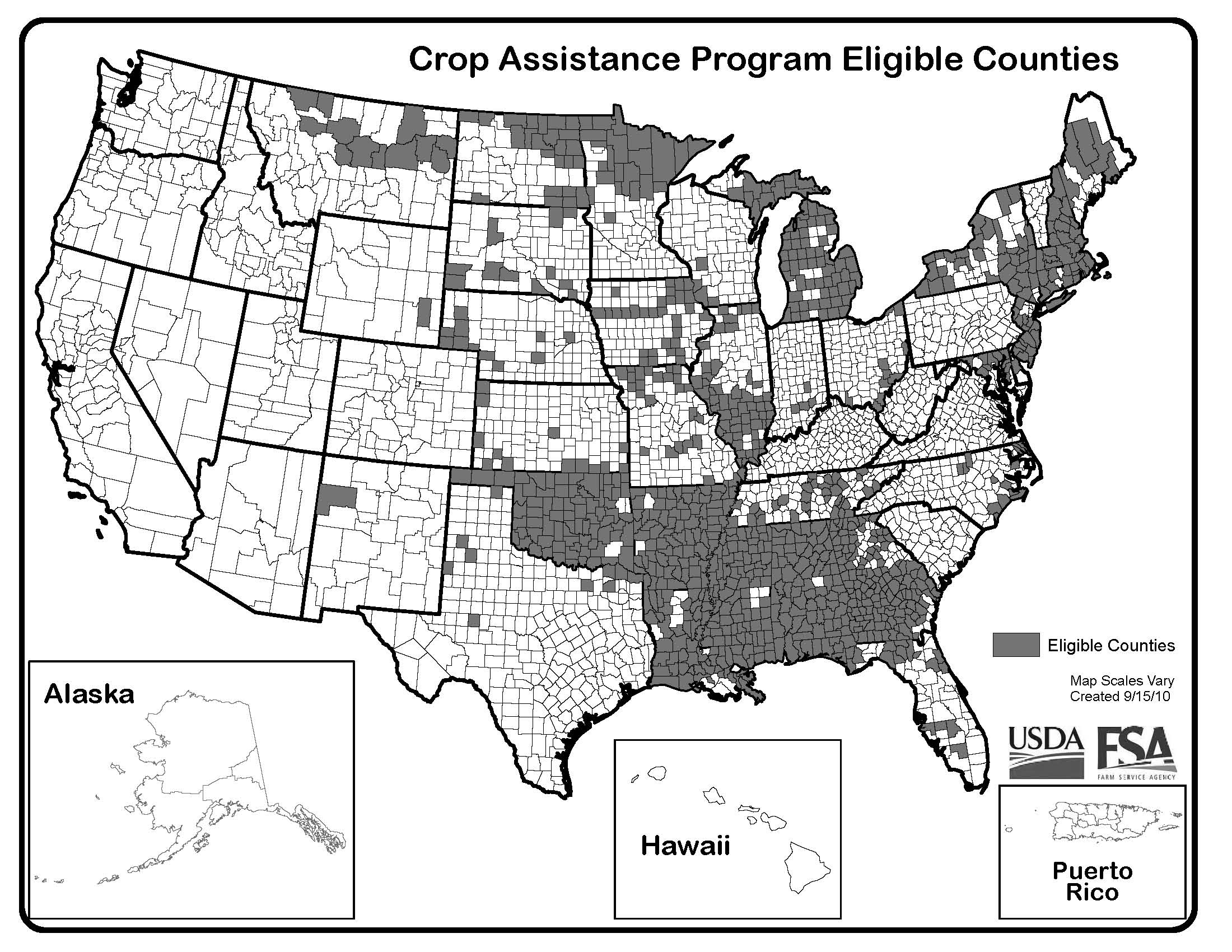
Payments will be made available to producers of eligible crops that received Secretarial disaster designations due to excessive moisture or related conditions in 2009.Producers of eligible crops on farms in disaster counties who certify to a 5 percent or greater crop loss in 2009 due to excessive moisture or related conditions will receive a payment based on a predetermined payment rate times the planted acres of the crop. Per acre payment rates will be prorated by FSA in order to keep payments within available funds for the program. Producers will initially receive 75 percent or their CAP payment and once sign up is complete they will receive up to an additional 25 percent. The predetermined payment rates for the eligible crops are:
Long grain rice – $31.93 per acre; Medium or short grain rice – $52.46 per acre; Upland Cotton – $17.70 per acre; Soybeans – $15.62 per acre; Sweet potatoes – $155.41 per acre. The general eligibility provisions, payment limits and adjusted gross income limits that apply to FSA programs apply to CAP. No person or legal entity (excluding a joint venture or general partnership), may receive, directly or indirectly, more than $100,000 in CAP benefits. Additionally, CAP payments will be treated as 2009 revenue under the Supplemental Revenue Assistance Payments (SURE) Program.
CAP is funded through Section 32 of the Agricultural Adjustment Act of Aug. 24, 1935, which allows the Secretary to use funds to reestablish the purchasing power of farmers, ranchers and producers. For additional background on CAP, visit http://disaster.fsa.usda.gov.
For more information about USDA Farm Service Agency disaster assistance programs, visit a local FSA county office or http://disaster.fsa.usda.gov.
USDA is an equal opportunity provider, employer and lender. To file a complaint of discrimination, write to USDA, Assistant Secretary for Civil Rights, Office of the Assistant Secretary for Civil Rights, 1400 Independence Avenue, S.W., Stop 9410, Washington, DC 20250-9410, or call toll-free at (866) 632-9992 (English) or (800) 877-8339 (TDD) or (866) 377-8642 (English Federal-relay) or (800) 845-6136 (Spanish Federal-relay). USDA is an equal opportunity provider and employer.
Monday, May 17, 2010
Samsung HZ35W compact ultra-zoom digital camera with GPS
I just got this camera for my impeding trip to Kenya and testing it. So far camera functions are superb, with 15x optical zoom and wide-angle lens, it is compact and takes great pictures on auto, but also have full manual control. What it lacks is printed manual and other detail instructions. The other BIG problem is GPS base maps. You will need to download them from www.samsungimaging.com, not samsung.com as stated in PDF manual. And, search for model WB650, not HZ35W. After jumping through the hoops I found this semi-direct link http://www.samsungimaging.com/learn/digital-camera-camcorder/productDetailView.do?forward=feature&prdCtgSeq=7&langPrdSeq=6037
You will need to agree to the terms, than enter serial code of your camera (on the bottom, HZ35W code will work) and check if code is valid. Than it will take you to download page. Manual for GPS basemaps is not download-able, no saveable and in scroll-down frame, after taking multiple screenshots, I was able to save it.
Now about the maps. Samsung states that 63 countries are covered, but You only have 3 attempts to download regional (country?) maps. Since others stated that getting 550 Mb map of US was a pain, I downloaded basemaps for whole world (required, ~100 mB) first, and then got Kenya, UK (for my possible venture into London during plane switch) and Russia/Ukraine. I was really surprised that those countries are available.:) Well, I just started US download, I got it in about 15 min, not bad. also I am not sure how detail those maps will be, but they are there!
After jumping through hoops, here is video how to, which is only available if you already went through all sites, entered serial number, etc. It teaches you how to do just that.:)
http://www.samsungimaging.com/learn/digital-camera-camcorder/goInstallGuideMovie.do
Pros:
1. Camera is pretty easy to use. Point and shoot and gets good pictures. Great wide angle + 15X optical! zoom.


2. Intelli-Studio for image editing is also straightforward. Camera connected fast with Win XP Pro PC, you don't even need to install Studio, it runs from camera. Camera is charging while uploads pictures.Short USB cable is actually a plus. It is proprietary by Samsung, so I have to be careful not to lose it. Old images are not removed from SD by default, but can be cleaned with a few clicks. I also installed the Studio to PC to download images into my Win Live folder which will automatically syncs between work and home PC. So I can work on images anytime from any comp. I am getting ready for netbook :) and planning to carry one with me on ventures around town/business travel. I am aware that netbooks do not have optical drive, so auto-install of software from camera instead of DVD is actually a plus! The software displays all info about each shot, including GPS coordinates, I am planning to use it in learning digital photography and may be for documenting my soil consulting trips and EC measurements.

3. GPS actually fixed pretty quickly, about 2 min max (for the first out of the box fix, not bad!) when I was sitting outside waiting for car oil change, and it was not clear view of skies, I was on the side of the hole in concrete awning, sort of an atrium. Even without base maps, it displays pretty accurate location of the picture (through Intelli-Studio, it even shows address of Car Spa I was sitting at). Accuracy spread was also OK for not dedicated GPS, considering I was siting not in the crear sky view. The popped out picture of the stones actually shown exactly where I was sitting, other pins are close by (I did not move while taking all 7 pictures), but this spread to be expected even on hight end GPS.
Cons:
1.No hard copy user manual is included. Manual is on CD (and that is only thing which is on that CD, pretty wasteful, as all base maps on web, and manual as well, why include CD?). Although I like PDFs and generally prefer having a softcopy on computer for referral, sometimes it is nice to being able to play with camera outside and refer to book manual. I should go through additional loops to convert PDF to use on Kindle or Win Mobile Phone. Or netbook?:)
2. Basemap download and install is not easily available, see above. Although I found it and downloaded relatively painlessly, I am still working on getting basemaps on camera SD, this will be separate post. Also space limits - I will have to fill about 1 Gb with base maps...
Conclusions: I really like this camera and can envision having it with me at all the times. I am not a good photographer, but like to learn. Also I follow the motto "the best camera is the one you have with you". We got DSLR Pentax for Christmas, but it is too heavy and complicated to my taste, so my husband took it over, he likes to play with images and spends hours on editing. Now he shoots in RAW mostly, now there is always at least a week lag before he can post pictures. I don't like this. So this little Samsung will be My Camera.:)
You will need to agree to the terms, than enter serial code of your camera (on the bottom, HZ35W code will work) and check if code is valid. Than it will take you to download page. Manual for GPS basemaps is not download-able, no saveable and in scroll-down frame, after taking multiple screenshots, I was able to save it.
Now about the maps. Samsung states that 63 countries are covered, but You only have 3 attempts to download regional (country?) maps. Since others stated that getting 550 Mb map of US was a pain, I downloaded basemaps for whole world (required, ~100 mB) first, and then got Kenya, UK (for my possible venture into London during plane switch) and Russia/Ukraine. I was really surprised that those countries are available.:) Well, I just started US download, I got it in about 15 min, not bad. also I am not sure how detail those maps will be, but they are there!
After jumping through hoops, here is video how to, which is only available if you already went through all sites, entered serial number, etc. It teaches you how to do just that.:)
http://www.samsungimaging.com/learn/digital-camera-camcorder/goInstallGuideMovie.do
Pros:
1. Camera is pretty easy to use. Point and shoot and gets good pictures. Great wide angle + 15X optical! zoom.


2. Intelli-Studio for image editing is also straightforward. Camera connected fast with Win XP Pro PC, you don't even need to install Studio, it runs from camera. Camera is charging while uploads pictures.Short USB cable is actually a plus. It is proprietary by Samsung, so I have to be careful not to lose it. Old images are not removed from SD by default, but can be cleaned with a few clicks. I also installed the Studio to PC to download images into my Win Live folder which will automatically syncs between work and home PC. So I can work on images anytime from any comp. I am getting ready for netbook :) and planning to carry one with me on ventures around town/business travel. I am aware that netbooks do not have optical drive, so auto-install of software from camera instead of DVD is actually a plus! The software displays all info about each shot, including GPS coordinates, I am planning to use it in learning digital photography and may be for documenting my soil consulting trips and EC measurements.
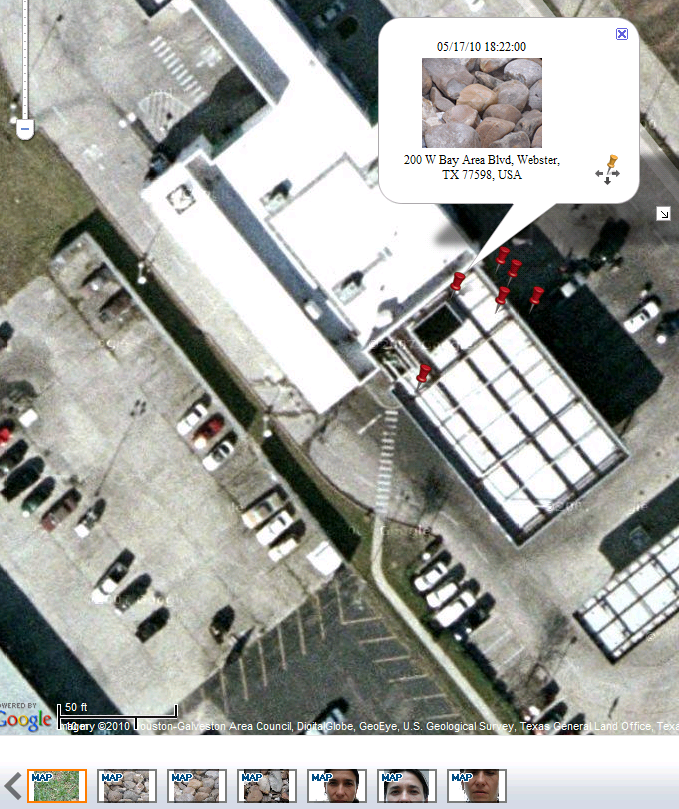
3. GPS actually fixed pretty quickly, about 2 min max (for the first out of the box fix, not bad!) when I was sitting outside waiting for car oil change, and it was not clear view of skies, I was on the side of the hole in concrete awning, sort of an atrium. Even without base maps, it displays pretty accurate location of the picture (through Intelli-Studio, it even shows address of Car Spa I was sitting at). Accuracy spread was also OK for not dedicated GPS, considering I was siting not in the crear sky view. The popped out picture of the stones actually shown exactly where I was sitting, other pins are close by (I did not move while taking all 7 pictures), but this spread to be expected even on hight end GPS.
Cons:
1.No hard copy user manual is included. Manual is on CD (and that is only thing which is on that CD, pretty wasteful, as all base maps on web, and manual as well, why include CD?). Although I like PDFs and generally prefer having a softcopy on computer for referral, sometimes it is nice to being able to play with camera outside and refer to book manual. I should go through additional loops to convert PDF to use on Kindle or Win Mobile Phone. Or netbook?:)
2. Basemap download and install is not easily available, see above. Although I found it and downloaded relatively painlessly, I am still working on getting basemaps on camera SD, this will be separate post. Also space limits - I will have to fill about 1 Gb with base maps...
Conclusions: I really like this camera and can envision having it with me at all the times. I am not a good photographer, but like to learn. Also I follow the motto "the best camera is the one you have with you". We got DSLR Pentax for Christmas, but it is too heavy and complicated to my taste, so my husband took it over, he likes to play with images and spends hours on editing. Now he shoots in RAW mostly, now there is always at least a week lag before he can post pictures. I don't like this. So this little Samsung will be My Camera.:)
Wednesday, May 12, 2010
Low-cost GPS logger
I had tested a small gadget called GPS logger from Columbus Visiontac.
Complete product name-description is:
Columbus V-900 User Manual V1.2 English Version updated 08-11-10 1.29M
 Time Album V1.8 English Version
Updated: 10-03-31 1132K
I will try to set up my new laptop with this and get those data out!
Setup instruction:
Complete product name-description is:
Columbus V-900 Bluetooth GPS Data Logger (microSD , Voice Tag for POI, Driverless, Push to Log, 25 millions waypoints*, XP / Vista/ Linux / Mac OSX Compatible)
I tested it on some trips about a year ago. It is out of stock on most websites now, I don't know whats going on, but I have it and it is a cool little device both for fun and for field research. The cool feature is if you carry your digital camera and set up time in it to minute upon return to office you can link those pictures with Lat/Long and post on Google Earth for other to review. Or you can collect voice notes or waypoints and then load them to your PC and merge with other measurements. If you have it in your car all the time, it trucks your routs and date-stamp them so you can review notes and places you've been and merge that with soil maps, satellite imagery, etc. Indispensable for mobile Ag Consultant! I even tried to log EC data from Landmapper to merge with locations. It has worked a year ago, but now dis-organized as I am, I lost manual and software which came with it for PC communication. It still works and I have a whole bunch of data on it from recent trip to Winnie, TX - I was there mapping soil salinity on rice fields, but I cannot get it out!:( I will continue searching internet and my house, but may be someone can help with this??? Ok, that was pretty easy. Here is manufacturer website for downloads.Current versions areColumbus V-900 User Manual V1.2 English Version updated 08-11-10 1.29M
Time Album V1.8 English VersionUpdated: 10-03-31 1132K
I will try to set up my new laptop with this and get those data out!
Setup instruction:
- Download and install Java (free, click here to download). It will ask you to verify your version of Java.
- Download and unzip the Time Album application (see link above).
- Launch the TimeAlbum application by double clicking on the unzip file above.
Tuesday, May 11, 2010
Solid Earth Geophysics Encyclopedia
Landmapper will be featured in 2nd edition of Solid Earth Geophysics Encyclopedia as the best small scale portable and accurate electrical resistivity/conductivity meter. Click here to read a draft of the article in 2nd edition of Encyclopedia.
1st edition Encyclopedia of Solid Earth Geophysics can be found here.
1st edition Encyclopedia of Solid Earth Geophysics can be found here.
James, D.E. (Ed.)
Version: eReference (online access)
1990, 1344 p. eReference.
ISBN: 978-0-387-30752-7
1990, 1344 p. eReference.
ISBN: 978-0-387-30752-7
Friday, March 26, 2010
APPLICATIONS OF SELF-POTENTIAL METHOD IN AGRICULTURE
full proceeding paper was presented at SAGEEP, April 11-15 2010, Keystone, CO.

 Electrical geophysical methods are classified as methods measuring natural electrical potentials of the ground without introducing additional electrical field and methods utilizing artificial electrical or electromagnetic fields to measure soil electrical parameters. Method of self-potential (SP) measures the naturally existing electrical potentials in soils and “bio-potentials” in plant, which are important in agriculture. Despite growing popularity of electrical resistivity/conductivity methods in precision agriculture, method of self-potential is rarely used. The SP method is based on measuring the natural potential differences, which generally exist between any two points in the soil or plant. Electrical potential in Soil-Plant system is a combination of the natural electrical potential differences on the interfaces inside soil (between soil horizons or peds), on the interfaces inside growing plant (between different plant tissues), as well as between soil and plant. The largest electrical potential differences were observed inside soils between soil horizons drastically different in physical and chemical properties. In most soils topsoil has higher electrical potentials than subsoil. The highest potential difference between soil horizons reported for Spodosols (40-60 mV), decreasing to 20-40 mV in Alfisoils and to ~20 mV in Mollisols, and even lower in Aridisols. Maps of electrical potentials in topsoil help to reveal the micro-environments for plant growth and correspond to plant biomes in natural ecosystems. Electrical resistivity (ER) or conductivity (EC) maps are generally similar to the maps of self-potentials, but using combination of those methods brings more information about infiltration and subsurface water fluxes and aid in search for clogged drainage pipes and reclamation planning. Recent advances in geophysical equipment, such as LandMapper ERM-02 also allow non-invasively measure natural electrical potentials between soils and plants, which are very small (µV magnitude), but nevertheless can be used to study plant water and nutrient stresses and manipulated to facilitate plant growth.
 Many kinds of electrical fields and potentials are often simultaneously observed in natural soil; thus, it is difficult to know what mechanism is responsible for their formation. Stationary electrical fields originated in deep geological formations can be observed in soils together with electrical fields of a various nature, arising directly in soil profiles (Semenov, 1980). The potentials originated in soil profiles were classified into diffusion-adsorption potentials, electrode potentials, and potentials of “varying in time fields" (Semenov, 1980). The “geological” potentials are limited to certain natural conditions, such as sharp change of oxidation-reduction conditions above an ore deposit or perched mineralized groundwater. The natural “soil” electrical potentials, on the contrary, can form under any soil condition.
 The SP method was used by Fox as early as 1830 on sulphide veins in a Cornish mine, but the systematic use of the SP and electrical resistivity methods in conventional geophysics dates from about 1920 (Parasnis, 1997). The SP method is based on measuring the natural potential differences, which generally exist between any two points on the ground. These potentials are associated with electrical currents in the soil. Large potentials are generally observed over sulphide and graphite ore bodies, graphitic shale, magnetite, galena, and other electronically highly conducting minerals (usually negative). However, SP anomalies are greatly affected by local geological and topographical conditions. These effects are considered in exploration geophysics as “noise”. The electrical potential anomalies over the highly conducting rock are usually overcome these environmental “noise”, thus, the natural electrical potentials existing in soils are usually not considered in conventional geophysics.
Perspective of self-potential method in environmental, agricultural and engineering applications

 Another possible environmental and engineering application of self-potential method is to study subsurface water movement. Measurements of electro-filtration potentials or streaming potentials have been used in Russia to detect water leakage spots on the submerged slopes of earth dams (Semenov, 1980). Method of self-potential in addition to EC mapping and vertical electrical sounding/ imaging (VES) can aid in archaeological and civil engineering projects (Pozdnyakova et al., 2001).
Larisa Golovko, Landviser, LLC, Houston, TX
Anatoly I. Pozdnyakov, Moscow State University, Moscow, Russia
View/download slides View/download full proceeding paper
citing this paper:
Abstract
citing this paper:
Golovko, Larisa, and A.I. Pozdnyakov. “Applications of Self-potential Method in Agriculture.” 8 p. on CD–ROM. Keystone, CO: Environmental and Engineering Geophysical Society, 2010. http://www.landviser.net/webfm_send/168.
Abstract

 Electrical geophysical methods are classified as methods measuring natural electrical potentials of the ground without introducing additional electrical field and methods utilizing artificial electrical or electromagnetic fields to measure soil electrical parameters. Method of self-potential (SP) measures the naturally existing electrical potentials in soils and “bio-potentials” in plant, which are important in agriculture. Despite growing popularity of electrical resistivity/conductivity methods in precision agriculture, method of self-potential is rarely used. The SP method is based on measuring the natural potential differences, which generally exist between any two points in the soil or plant. Electrical potential in Soil-Plant system is a combination of the natural electrical potential differences on the interfaces inside soil (between soil horizons or peds), on the interfaces inside growing plant (between different plant tissues), as well as between soil and plant. The largest electrical potential differences were observed inside soils between soil horizons drastically different in physical and chemical properties. In most soils topsoil has higher electrical potentials than subsoil. The highest potential difference between soil horizons reported for Spodosols (40-60 mV), decreasing to 20-40 mV in Alfisoils and to ~20 mV in Mollisols, and even lower in Aridisols. Maps of electrical potentials in topsoil help to reveal the micro-environments for plant growth and correspond to plant biomes in natural ecosystems. Electrical resistivity (ER) or conductivity (EC) maps are generally similar to the maps of self-potentials, but using combination of those methods brings more information about infiltration and subsurface water fluxes and aid in search for clogged drainage pipes and reclamation planning. Recent advances in geophysical equipment, such as LandMapper ERM-02 also allow non-invasively measure natural electrical potentials between soils and plants, which are very small (µV magnitude), but nevertheless can be used to study plant water and nutrient stresses and manipulated to facilitate plant growth.
Introduction

All the natural electrical fields can be classified by mechanisms and nature of their occurrence in two large groups: electrical fields of stationary processes, existing on the contacts of various media and non-stationary, transient, electrical fields, arising in saturated and unsaturated soils due to movement of soil solutions. The most widespread electrical fields in soils are attributable to diffusion-adsorption potentials, in which sorption typically contributes more than diffusion. The natural electrical fields are measured together with electrode potentials, which can be considered as artificially created potentials on the contacts of electrodes with soil.
Natural electrical fields and their potentials were studied in some soils in Russia (Borovinskaya, 1970; Vadunina, 1979; Pozdnyakov et al., 1996). Vadunina (1979) indicated that potentials measured on the soil surface could be used to estimate different soil properties in the whole soil profile. The measurements of natural potentials on the surface of some Aridisols (including Natrargids) and Alfisols (Pozdnyakov et al., 1996) show that such estimation is possible only when the surface soil horizons are genetically related to the other horizons in the soil profile.
We consider soil electrical potentials as diffusion-adsorption potentials on the contacts of different soil structures, such as soil aggregates, horizons, and pedons in topographic sequences. This concept, based on Poisson’s and Maxwell’s laws of electromagnetism and Boltzmann’s distribution law of statistical thermodynamics, was used to explain relationships among various soil properties, mobile electrical charges, and electrical parameters. The theory considers soil cover as a huge "source" generating natural electrical fields and allows constructing models of electrical profiles in various soils.
History of self-potential method in geophysical prospecting

In soil studies researchers are especially interested in the measurement of such “noise” electrical potentials created in soils due to soil-forming process and water/ion movements. The electrical potentials in soils, clays, marls, and other water-saturated and unsaturated sediments can be explained by such phenomena as ionic layers, electro-filtration, pH differences, and electro-osmosis. Soil-forming processes can create electrically variable horizons in soil profiles, thus electrical potential differences measured between soil horizons can be used to study soil forming processes and soil genesis.


Subscribe to:
Posts (Atom)
